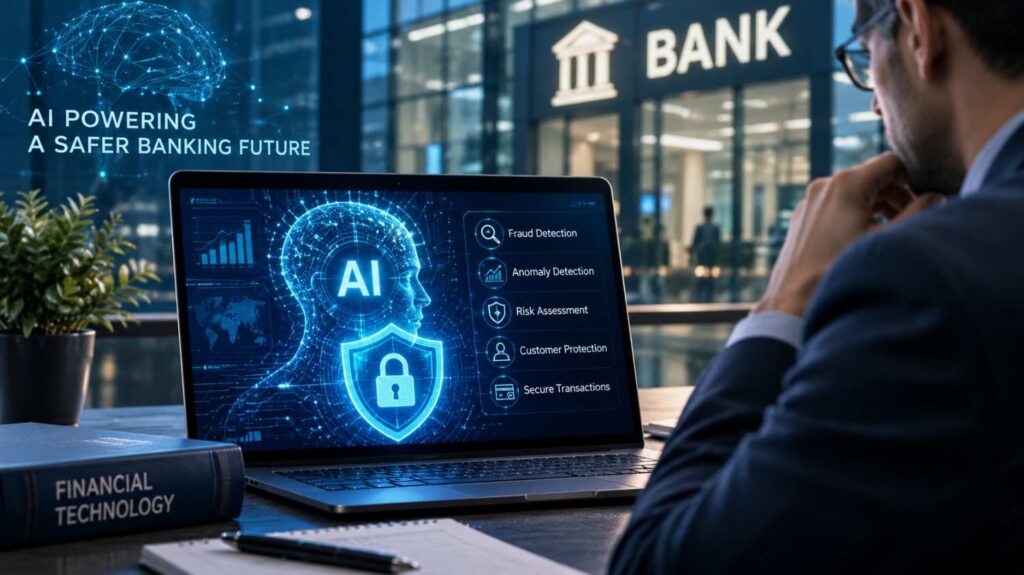
How AI Is Reshaping Cybersecurity in Banking
Banks operate in one of the most targeted and highly regulated digital environments in the world. Every online payment, mobile login, credit-card authorization, loan application, customer-service interaction, and third-party connection can produce data that must be analyzed and protected. Traditional controls remain essential, but the volume and speed of modern banking activity make it increasingly difficult for human teams and static rules to identify every significant threat.
Artificial intelligence changes this situation by helping banks analyze large datasets, detect unusual patterns, prioritize security alerts, and investigate suspicious activity more efficiently. Machine-learning systems can compare current behavior with historical patterns, while generative AI tools can help security professionals summarize incidents, review threat intelligence, and navigate complex technical documentation. These capabilities can improve the speed and consistency of banking cybersecurity operations when they are used responsibly.
However, the same technology is also available to criminals. Attackers can use generative AI to improve phishing messages, create synthetic identity documents, imitate trusted individuals, discover vulnerable systems, and automate elements of fraud. AI therefore strengthens both sides of the cybersecurity contest.
Understanding how AI is reshaping cybersecurity in banking requires more than listing new tools. Banks must consider how AI affects fraud prevention, customer authentication, data privacy, operational resilience, third-party risk, model governance, employee behavior, and regulatory accountability. The strongest approach combines AI-powered analysis with established security controls and meaningful human oversight.
How AI Is Reshaping Cybersecurity in Banking Today
AI adoption in banking is moving from isolated experiments into operational systems that affect fraud detection, customer service, software development, risk analysis, and security monitoring. In June 2026, the European Central Bank stated that more than 85% of significant banks under European banking supervision were using artificial intelligence. The ECB also emphasized that AI can strengthen IT security while simultaneously improving the capabilities available to malicious actors.
This combination of widespread adoption and dual-use risk creates a major strategic challenge. Banks cannot treat AI only as an innovation project managed by technology teams. Its use affects cybersecurity, privacy, compliance, legal responsibilities, third-party oversight, operational resilience, and customer trust.
The current transformation is therefore not defined by one product or algorithm. It is defined by the growing use of AI across connected banking processes. Security teams must protect AI systems, use AI to defend traditional infrastructure, and prepare for AI-enhanced attacks. Banks that coordinate these responsibilities across departments will be better positioned than institutions that manage each AI use case in isolation.
Banks evaluating both the opportunities and security implications of AI can also benefit from understanding how generative AI in banking is influencing financial operations beyond cybersecurity.
Banks Have More Data and a Larger Attack Surface
Modern banks collect and process large volumes of data from mobile applications, web portals, payment platforms, ATMs, branches, cloud environments, identity services, customer-support systems, application programming interfaces, and external service providers. This information gives AI systems more context for detecting threats, but it also creates more points that attackers may attempt to exploit.
The attack surface expands further when banks connect AI tools to internal documents, customer records, software repositories, ticketing systems, or security platforms. Every integration can create additional permissions, data flows, and dependencies. A model may be secure in isolation while the surrounding application exposes information through weak access controls or poorly designed interfaces.
ENISA’s finance-sector threat analysis reviewed incidents reported between January 2023 and June 2024 and identified credit institutions as the most frequently affected financial entity type, with 301 incidents representing 46% of affected entities in the report’s dataset. This finding reinforces the need for banks to maintain accurate asset inventories and understand where sensitive information moves throughout increasingly complex environments.
Attack Speed Is Challenging Static Security Rules
Static security rules are valuable because they provide predictable and explainable controls. They can block known malicious domains, enforce transaction limits, detect recognized malware signatures, and alert teams when specific policy conditions are violated. Their limitation is that attackers frequently adjust their behavior to avoid known thresholds and indicators.
AI-assisted monitoring can evaluate combinations of weaker signals that would not trigger a traditional rule independently. For example, a login from a familiar city may appear safe, but it becomes more suspicious when combined with a new device, an unusual browser configuration, a recent password reset, and an immediate attempt to add a payment beneficiary.
Attack speed also affects vulnerability management. Verizon’s 2026 Data Breach Investigations Report stated that vulnerability exploitation had become the initial access route for 31% of breaches in its dataset. Verizon also reported that generative AI was strengthening multiple attack techniques by helping threat actors move faster during activities such as identifying security weaknesses. Banks therefore need faster prioritization, patching, detection, and containment without abandoning careful testing.
AI Has Become a Dual-Use Technology
A dual-use technology can support legitimate goals while also enabling harmful activity. AI fits this description because its core capabilities—language generation, pattern recognition, prediction, classification, automation, and content creation—can benefit defenders and attackers at the same time.
A security analyst may use a language model to summarize malware behavior or translate a technical alert into a clear management update. A criminal may use similar technology to create convincing phishing emails, impersonate an employee, or produce different versions of a scam for thousands of potential victims. Image, audio, and video generation can support legitimate customer experiences, but the same capabilities can make fraudulent identity documents and impersonation attempts more persuasive.
This dual-use nature makes simple policies such as “allow AI” or “ban AI” ineffective. Banks need to evaluate specific use cases, information types, access levels, and potential consequences. The central question is not whether AI is inherently safe or unsafe. The more useful question is whether a particular application has appropriate controls, reliable monitoring, clear accountability, and a risk level the institution is prepared to accept.
How AI Strengthens Banking Cybersecurity
AI is particularly useful when security teams must find meaningful patterns within large, fast-moving datasets. Banks process enormous numbers of events every day, including transactions, logins, password changes, device registrations, employee access requests, network connections, and software alerts. Reviewing each event manually would be impractical and inefficient.
AI-powered threat detection can help reduce this burden by scoring activity, grouping related events, and directing attention toward cases with stronger indicators of risk. The Bank for International Settlements reported that surveyed central-bank cybersecurity experts expected generative AI tools to improve threat detection and reduce response time, although they also identified increased risks from social engineering and unauthorized information disclosure.
The strongest results usually come from combining multiple controls. AI can provide risk signals, but those signals become more valuable when paired with identity verification, multifactor authentication, network segmentation, transaction limits, and trained investigators. This layered approach allows banks to benefit from adaptive analysis without becoming dependent on a single model.
| AI Technology | Primary Cybersecurity Function | Banking Use Case | Key Benefit |
|---|---|---|---|
| Machine Learning | Detects unusual behavior patterns | Transaction monitoring | Identifies suspicious financial activity faster |
| Behavioral Biometrics | Verifies user behavior | Login and account protection | Reduces account takeover risks |
| Generative AI | Automates analysis and reporting | Security operations support | Speeds up incident investigation |
| Predictive Analytics | Forecasts emerging threats | Fraud risk assessment | Improves proactive threat detection |
| Natural Language Processing (NLP) | Analyzes text-based threats | Phishing and email monitoring | Detects malicious communication more accurately |
| AI-Powered Anomaly Detection | Monitors network and payment activity | Real-time fraud prevention | Minimizes false positives while improving detection |
Detecting Anomalies and Account Takeover
Account takeover occurs when an unauthorized person gains control of a legitimate customer or employee account. Attackers may use stolen passwords, session tokens, social engineering, malware, or weaknesses in account-recovery processes. Because the attacker is using a valid account, simple access checks may not be enough to identify the intrusion.
AI-assisted anomaly detection can compare current activity with established behavioral patterns. The system may examine device history, login timing, navigation behavior, transaction sequences, IP reputation, authentication methods, and changes to contact information. A single difference may be harmless, but several unusual events occurring together can justify additional verification.
For example, a customer may log in from a new device while traveling, which should not automatically be treated as fraud. Risk increases if the login is followed by a password change, the addition of a new payment recipient, and an unusually large transfer. AI helps connect these signals, while bank policies determine the response.
The system should also explain which factors influenced the alert. Investigators need enough context to distinguish a genuine compromise from legitimate customer behavior and avoid unnecessary account restrictions.
Improving Fraud and Identity Verification
AI fraud detection in banking extends beyond examining individual transactions. Machine-learning systems can identify relationships among accounts, devices, addresses, beneficiaries, identity documents, and payment patterns. These connections may reveal coordinated fraud networks that are difficult to detect through isolated rules.
Behavioral biometrics can add another layer of information by analyzing how a person interacts with a device or application. Signals may include typing rhythm, touchscreen pressure, mouse movements, navigation speed, and the sequence of actions completed during a session. These indicators can support risk assessment without becoming the sole basis for rejecting a customer.
AI is also becoming increasingly relevant to identity verification because criminals can create synthetic images, altered documents, and deepfake audio or video. FinCEN reported increased suspicious activity reporting involving suspected deepfake media, particularly fraudulent identity documents intended to bypass verification and authentication controls.
Banks should combine automated document analysis with liveness testing, device intelligence, database checks, and human review for higher-risk cases. No single verification method should be trusted without considering the wider context.
Supporting Security Operations Teams
Security operations centers often receive more alerts than analysts can investigate immediately. Many alerts are duplicates, low-risk events, or parts of the same incident. AI can help by correlating related activity, enriching alerts with threat intelligence, summarizing event histories, and recommending an investigation order based on potential impact.
For example, an AI-assisted platform might connect a suspicious employee login, an unusual data transfer, and a new process running on the same device. Instead of presenting three unrelated alerts, it can create one case showing the likely sequence of events. This gives the analyst a clearer starting point and can reduce time spent moving between systems.
Generative AI may also help analysts query technical data using natural language or draft incident summaries for different audiences. However, generated explanations can be incomplete or inaccurate. Analysts should verify important conclusions against original logs, system records, and trusted threat-intelligence sources.
Banking cybersecurity automation should therefore remove repetitive work without removing professional judgment. The objective is to give analysts better context and more time for complex investigation, containment, recovery, and communication.
How AI Creates New Cybersecurity Risks for Banks
AI can strengthen security, but every AI implementation also introduces new risks that must be managed. The risk does not exist only inside the model. It can arise from training data, user prompts, connected databases, application permissions, software libraries, external providers, generated outputs, and the business decisions made from those outputs.
Banks must also account for speed. Employees can adopt public AI services quickly, sometimes before security, privacy, or legal teams know those tools are being used. Developers may connect models to internal systems during experimentation, while business teams may upload documents containing information that should remain restricted.
IBM’s 2025 research found that 97% of surveyed organizations reporting an AI-related security incident lacked proper AI access controls. IBM also reported that 63% of organizations in its related research either lacked an AI governance policy or were still developing one.
These findings do not mean banks should avoid AI. They show that security and governance must develop at the same pace as adoption. An innovative system becomes a liability when the institution cannot identify its users, data, permissions, dependencies, limitations, and possible failure modes.
AI-Enhanced Phishing, Deepfakes and Social Engineering
Phishing and social engineering depend on persuading a person to trust a false message or request. Generative AI can make these attacks more effective by improving grammar, imitating professional communication styles, translating messages, and personalizing content using information gathered from public or stolen sources.
Deepfake technology adds another layer of credibility. A criminal may attempt to imitate an executive’s voice, create a video resembling a trusted colleague, or produce synthetic identity materials. These techniques can be used to request payments, change account details, reset credentials, or persuade employees to reveal confidential information.
FinCEN’s deepfake alert confirms that financial institutions have reported suspected use of synthetic media in fraudulent identity documents and related schemes. Banks should therefore treat voice and video as supporting evidence rather than unquestionable proof of identity.
High-risk actions should require independent verification. Employees can call a previously recorded number, use an approved internal channel, confirm the request with another authorized person, or require additional authentication. The most effective defense combines technology with procedures that remain reliable even when digital content looks and sounds convincing.
Data Leakage and Shadow AI
Shadow AI refers to AI tools or uses that operate outside an organization’s approved governance and security processes. It may involve an employee using a public chatbot, a department purchasing an AI service without central review, or a developer connecting an external model to internal data during an unofficial experiment.
The immediate risk is sensitive-data exposure. A bank employee might paste customer records, investigation notes, internal policies, authentication information, software code, or confidential business plans into an unapproved service. Even when the user has no harmful intention, the institution may lose control over where that information is processed, stored, logged, or reviewed.
Banning every AI service is rarely sufficient because employees may continue using convenient tools without reporting them. A stronger approach provides approved alternatives, clear data-classification rules, practical training, technical restrictions, and a simple process for requesting new use cases.
Banks should explain exactly which information may never enter an external AI system. They should also monitor network activity and identity logs for unapproved services. Effective governance makes secure behavior easier rather than relying entirely on employees to recognize complex technical and contractual risks.
Model Manipulation and Third-Party Dependence
AI systems may be manipulated through malicious inputs, poisoned data, deceptive prompts, compromised software components, or weaknesses in connected applications. An attacker may attempt to influence a model’s output, extract restricted information, bypass safety controls, or cause the system to take an unintended action.
The risk becomes more serious when an AI model can access internal documents, generate software commands, update records, or communicate with other systems. Banks should limit permissions according to the principle of least privilege. A system designed to summarize alerts should not automatically receive authority to disable accounts or modify payment records unless that capability is required and carefully controlled.
Third-party dependence creates additional concerns. Many banks rely on external cloud providers, model developers, identity services, data vendors, and cybersecurity platforms. A failure or compromise at one provider can affect multiple processes.
FS-ISAC has highlighted AI-enabled fraud, attacks on suppliers, and growing technology dependence among important financial-sector resilience concerns. Banks need vendor assessments, contractual security requirements, incident-notification procedures, fallback options, concentration-risk reviews, and tested plans for operating when an important provider becomes unavailable.
Related Articles
AI Security Compared With Traditional Banking Controls
AI security and traditional cybersecurity controls should not be treated as competing alternatives. Established controls provide predictable protection against known risks, while AI can add contextual analysis and adaptability. A mature bank uses both approaches within a layered defense strategy.
Traditional rules remain valuable for enforcing explicit requirements. A bank may block access after repeated failed authentication attempts, reject prohibited software, require approval for large payments, or prevent an employee from accessing data outside an assigned role. These controls are understandable, testable, and relatively easy to audit.
AI is more useful when the decision depends on complex relationships or changing behavior. It can assess whether a payment resembles previous legitimate transactions, whether a login sequence indicates account takeover, or whether several low-severity alerts may belong to one coordinated attack.
The following comparison shows where each approach can contribute. The final safeguard column is important because neither traditional rules nor AI should operate without governance, testing, and accountability.
| Banking Security Area | Traditional Approach | AI-Enabled Approach | Essential Safeguard |
|---|---|---|---|
| Fraud monitoring | Fixed rules and transaction thresholds | Behavioral and network-based risk scoring | Human review for high-impact decisions |
| Phishing defense | Domain, signature, and keyword matching | Language, sender, and behavioral analysis | Independent verification of unusual requests |
| Security alert handling | Manual queue review | Alert correlation, summarization, and prioritization | Analyst validation and audit logs |
| Identity verification | Documents, passwords, and security questions | Liveness, device, and behavioral analysis | Alternative verification and appeal procedures |
| Vulnerability management | Severity-based patch lists | Prioritization using exposure and threat context | Accurate asset inventory and tested patching |
| Threat intelligence | Manual review of reports | Automated extraction and relationship mapping | Source validation and confidence scoring |
Where AI Performs Best
AI performs best in situations involving large data volumes, repeating patterns, changing behavior, and the need to prioritize limited human attention. Transaction monitoring is a strong example because a bank may need to evaluate millions of payments while identifying a small number that require investigation.
AI can also support threat hunting by identifying unusual connections among devices, accounts, applications, and network activity. In vulnerability management, it may help security teams consider technical severity together with asset importance, internet exposure, active exploitation, and available compensating controls. This approach can produce a more useful repair order than relying only on a general severity score.
Another valuable application is information organization. Generative AI can summarize long incident records, extract indicators from threat reports, or help analysts search internal procedures. These uses improve efficiency without giving the system final authority over customers or critical systems.
The best AI use cases have measurable outcomes and accessible evidence. Banks should be able to determine whether the system reduces investigation time, improves detection, or lowers false-positive rates. A system that produces impressive demonstrations but cannot be measured in daily operations may not provide meaningful security value.
Where Traditional Controls Still Matter
Traditional controls remain the foundation of banking cybersecurity. Multifactor authentication, encryption, secure configuration, network segmentation, access reviews, patching, backups, change management, and incident-response planning address risks that AI cannot eliminate. A sophisticated model cannot compensate for an internet-facing system that remains unpatched or an employee account with unnecessary administrative privileges.
Rules are also preferable when a requirement must be enforced consistently. If only two authorized employees can approve a payment above a defined threshold, the system should apply that rule directly rather than ask an AI model to interpret whether approval is necessary.
Verizon’s 2026 finding that vulnerability exploitation accounted for 31% of initial breach access in its dataset shows why basic cyber hygiene remains important even as AI capabilities expand.
Banks should therefore avoid replacing deterministic controls simply because AI appears more advanced. The stronger strategy is to let traditional controls establish firm boundaries while AI identifies patterns, prioritizes activity, and provides additional context. Innovation should strengthen the control environment rather than make essential protections less predictable or harder to audit.
How Banks Can Implement AI Securely
Secure AI adoption begins with a defined business need and a clear understanding of risk. Banks should not start with a model and then search for a problem it might solve. They should begin by identifying an operational challenge, such as delayed fraud investigations, excessive false positives, slow vulnerability prioritization, or difficulty analyzing security alerts.
The use case should then be evaluated according to the information involved, the decisions supported, the possible customer impact, and the consequences of failure. A tool that summarizes public threat reports presents a different risk level from a system that can freeze accounts or influence transaction approvals.
Governance must cover the complete AI lifecycle. This includes design, procurement, development, testing, deployment, monitoring, modification, and retirement. It also includes external tools embedded in software products, because a bank may be using AI even when it did not build the model itself.
NIST’s AI Risk Management Framework organizes activities around Govern, Map, Measure, and Manage. NIST Cybersecurity Framework 2.0 separately organizes cybersecurity outcomes around Govern, Identify, Protect, Detect, Respond, and Recover. Together, these resources can help banks connect AI-specific risk management with established cybersecurity practices.
| Implementation Area | Recommended Action | Business Impact | Security Priority |
|---|---|---|---|
| AI Governance | Define policies and accountability | Better regulatory compliance | High |
| Data Protection | Classify and secure sensitive banking data | Prevents unauthorized exposure | High |
| Model Validation | Regularly test AI models for accuracy | Improves reliability | High |
| Employee Training | Educate staff on secure AI usage | Reduces Shadow AI risks | Medium |
| Third-Party Risk Management | Assess AI vendors and cloud providers | Strengthens supply-chain security | High |
| Continuous Monitoring | Track AI performance and security events | Detects issues before they escalate | High |
Step 1 — Govern and Classify the Use Case
The first step is to create an accurate inventory of AI systems. The inventory should include internally developed models, external AI services, AI features embedded in purchased software, employee productivity tools, experimental projects, and systems operated by important third parties.
Each use case should then be classified according to risk. Relevant factors include customer impact, data sensitivity, operational importance, decision authority, external connectivity, explainability, and the difficulty of reversing an incorrect outcome. A tool that drafts internal text may require basic controls, while an autonomous system that can alter account status requires far stronger oversight.
Banks should document who owns the system, who approves its use, which data it may access, and which decisions it may influence. Responsibilities for security, privacy, compliance, model testing, vendor management, and business performance must be clear.
NIST describes governance as a function that applies across the AI lifecycle and supports documented responsibilities, policies, and risk-management processes. This structure helps prevent AI from becoming an isolated technology project with unclear accountability when problems occur.
Step 2 — Test the Model, Data and Security Controls
Testing should examine more than whether the model produces accurate results under normal conditions. Banks need to evaluate data quality, false positives, false negatives, unauthorized access, manipulated inputs, privacy exposure, system resilience, and the consequences of incorrect recommendations.
Security testing should include attempts to extract restricted data, bypass instructions, misuse connected tools, escalate permissions, and influence results through malicious prompts or corrupted information. When an AI application can interact with other systems, testing must cover the complete workflow rather than only the model interface.
Banks should also evaluate whether training and operational data represent the situations the system will encounter. A fraud model trained on outdated behavior may perform poorly when payment methods or criminal tactics change. Performance should be measured across relevant customer groups and transaction types.
Before deployment, the institution needs acceptance thresholds and fallback procedures. The team should know what level of error is tolerable, when the system must be withdrawn, and how operations will continue without it. Independent review is particularly important for systems that influence customers, critical infrastructure, regulatory obligations, or high-value financial decisions.
Step 3 — Monitor, Validate and Keep Humans Accountable
AI risk management continues after deployment. Models can deteriorate as data changes, customer behavior evolves, new fraud patterns emerge, or connected systems are modified. Banks should monitor performance, usage, access, incidents, overrides, and unexpected outcomes throughout the system’s life.
Logging should capture model versions, significant prompts, data sources, recommendations, human decisions, and system actions where appropriate. These records help investigators understand what happened during an incident and support internal review, audit, and regulatory communication.
Human accountability must remain explicit. Employees should know when they are expected to challenge an AI result, when secondary approval is required, and who has authority to suspend the system. Human oversight should be meaningful rather than a routine approval step that rarely questions automated recommendations.
In April 2026, the Federal Reserve, FDIC, and OCC issued revised interagency model-risk guidance emphasizing an approach tailored to a bank’s size, complexity, and model-risk profile. Federal Reserve commentary also clarified that the revised traditional guidance does not serve as a complete framework for generative or agentic AI. Banks should therefore combine model validation with wider AI, cybersecurity, privacy, and operational-risk governance.
Quick Answer About How AI Is Reshaping Cybersecurity in Banking
AI is transforming banking cybersecurity by enabling financial institutions to analyze transactions, user behavior, identity signals, network activity, and security alerts at a scale that manual teams cannot match. It can help detect account takeover, suspicious payments, malware activity, insider risk, and unusual access patterns more quickly.
At the same time, AI introduces new risks. Criminals can use generative tools to produce convincing phishing campaigns, deepfake communications, fraudulent documents, and highly personalized scams. Banks also face internal risks from uncontrolled AI use, sensitive-data exposure, unreliable model outputs, and dependence on external technology providers.
The practical result is an AI-driven security environment in which automation alone is not enough. Banks need strong access controls, approved-use policies, model testing, data governance, incident planning, and human accountability. AI works best as a force multiplier for trained security and fraud professionals rather than as an unsupervised replacement for established controls.
What Is Changing for Banks?
The most important change is the movement from purely rule-based security toward systems that can evaluate patterns, context, and relationships. A traditional fraud rule might flag every transaction above a fixed amount. An AI-assisted system can consider the amount together with the customer’s previous behavior, device history, login location, payment recipient, transaction timing, and recent account changes.
This contextual approach can help banks identify suspicious activity that does not match a known rule. It may also reduce unnecessary alerts by recognizing legitimate customer behavior that appears unusual when viewed in isolation. The objective is not to remove rules but to add another analytical layer.
AI is also changing how security teams work. Analysts can use automated tools to group related alerts, summarize incident histories, search threat data, and prioritize cases. As adoption expands, banking cybersecurity becomes less focused on reviewing every event manually and more focused on validating high-risk findings, supervising automated workflows, and responding to situations in which several weak signals combine into a meaningful threat.
What Does This Mean in Practice?
In practice, banks should begin by identifying the security problems AI is expected to solve. Suitable examples include reducing false-positive fraud alerts, detecting compromised accounts earlier, prioritizing vulnerable systems, or helping analysts investigate incidents more efficiently. A clearly defined purpose makes it easier to select relevant data, establish performance measures, and determine whether the system is producing genuine value.
Banks must also define decision boundaries. AI may recommend that a transaction receive additional review, but the bank should decide whether the system can delay the payment automatically, request stronger authentication, or close the account. The more significant the customer or operational impact, the more important human review becomes.
AI deployment should therefore include documented escalation paths, approval responsibilities, logging, monitoring, and fallback procedures. When a model is unavailable, performs poorly, or produces an unexplained result, employees need a reliable alternative. The practical goal is controlled automation: AI accelerates analysis, while established policies and accountable professionals determine how consequential actions are taken.
Frequently Asked Questions About AI in Banking Cybersecurity
Questions about AI in banking often focus on whether the technology can stop fraud, replace employees, or introduce unacceptable risk. The most accurate answers are usually balanced. AI can improve detection and efficiency, but its effectiveness depends on data quality, integration, governance, and the controls that surround it.
It is also important to distinguish different forms of AI. A machine-learning model that scores transactions is not the same as a generative AI assistant that summarizes documents, and neither is identical to an agentic system that can take actions across connected applications. Each category creates different benefits and failure modes.
The following answers address common search questions in clear language while preserving the detail needed by security professionals, banking leaders, compliance teams, and technology decision-makers.
How Is AI Used in Banking Cybersecurity?
Banks use AI to analyze transactions, account activity, employee behavior, devices, network events, identity signals, software alerts, and threat-intelligence information. The technology can help identify unusual patterns that may indicate fraud, malware, credential theft, account takeover, or unauthorized access.
In a security operations center, AI may group related alerts, add contextual information, and summarize the sequence of an incident. In fraud prevention, machine-learning models may score transactions by comparing them with historical behavior and known fraud patterns. Identity teams may use automated document analysis, liveness checks, and device intelligence to support verification.
AI is also used to prioritize vulnerabilities and help analysts search large collections of technical data. These systems generally provide recommendations or risk scores rather than absolute proof.
The most effective programs combine AI with established controls such as multifactor authentication, secure configuration, transaction limits, employee training, and human investigation. AI improves the speed and scale of analysis, but the bank remains responsible for the quality and consequences of its decisions.
Can AI Prevent Banking Fraud?
AI can reduce the likelihood and impact of banking fraud, but it cannot prevent every fraudulent transaction. Criminals change tactics, legitimate customer behavior varies, and some attacks exploit people or processes rather than technical systems. No individual model can account for every situation.
AI is most effective when it analyzes several types of information together. A transaction may be evaluated using the customer’s history, device, location, recipient, transaction timing, recent account changes, and authentication method. When several risk indicators appear at once, the system can request stronger verification or direct the case to an investigator.
Banks must balance fraud prevention with customer access. An overly sensitive model may block legitimate payments and create frustration, while a weak model may miss meaningful threats. Continuous testing helps institutions adjust this balance.
The strongest fraud-prevention strategy combines AI with payment limits, customer notifications, identity verification, employee procedures, and rapid incident response. AI should be viewed as an important analytical layer within a broader control environment rather than a complete fraud solution.
Can Hackers Use AI to Attack Banks?
Yes. Criminals can use AI to improve phishing messages, create fake documents, imitate voices, personalize scams, analyze stolen information, and accelerate portions of the attack process. These tools can make social-engineering campaigns more convincing and allow attackers to produce many variations quickly.
AI may also help criminals identify vulnerable technologies or understand publicly available technical information. Verizon’s 2026 reporting described generative AI as strengthening several observed attack techniques and noted that vulnerability exploitation had become a leading initial access method in its breach dataset.
However, AI does not remove the need for an exploitable weakness. Attackers still depend on stolen credentials, unpatched software, weak verification, excessive permissions, misconfigured systems, or human mistakes.
Banks can reduce the threat by strengthening basic security, verifying unusual requests independently, patching exposed systems quickly, training employees to recognize impersonation, and monitoring for abnormal account behavior. Defensive AI can also help identify attack patterns, but it must operate within a well-maintained cybersecurity program.
What Is the Biggest Generative AI Risk for Banks?
There is no single biggest risk for every bank because the answer depends on the institution’s systems, services, data, and AI use cases. However, uncontrolled access to sensitive information is one of the most immediate concerns. Employees may enter confidential material into public tools, or an AI-connected application may receive broader permissions than it needs.
Deepfake fraud and social engineering are also significant because they target human trust. A realistic voice or video may persuade an employee or customer to approve a payment, reveal credentials, or change account information. FinCEN has documented increased suspicious activity reporting involving suspected deepfake media and fraudulent identity materials.
Other major risks include unreliable outputs, manipulated prompts, third-party concentration, weak monitoring, and systems that take actions without adequate supervision.
The most dangerous situation is often not one technical weakness. It is rapid deployment without an accurate inventory, clear ownership, appropriate access controls, tested limitations, or incident procedures. Governance determines whether individual risks remain manageable or combine into a larger operational problem.
How AI Is Reshaping Cybersecurity in Banking Without Replacing People?
AI is reshaping security work primarily by changing how professionals gather, review, and prioritize information. It can analyze large datasets, summarize alerts, extract technical indicators, and identify patterns more quickly than manual review alone. This allows employees to spend more time on complex investigation and decision-making.
Cybersecurity professionals still provide context that models may not understand. An analyst can consider business operations, customer circumstances, regulatory obligations, current threat intelligence, and the possible consequences of an automated action. People are also responsible for communicating during incidents, coordinating recovery, and deciding whether risk is acceptable.
Some repetitive tasks may become increasingly automated, but banking cybersecurity includes responsibilities that require judgment, accountability, negotiation, and ethical reasoning. A model can recommend that an account appears suspicious, but the bank must determine whether to delay a payment, contact the customer, report activity, or restrict access.
The likely future is therefore not AI replacing security teams. It is human-led cybersecurity in which professionals supervise more capable analytical tools and remain accountable for decisions affecting customers and critical banking services.
What Framework Should Banks Use to Govern AI?
Banks should use a combination of frameworks rather than expecting one document to address every AI risk. The NIST AI Risk Management Framework provides a useful structure through its Govern, Map, Measure, and Manage functions. It helps organizations define responsibilities, understand use-case risks, evaluate system performance, and respond to identified concerns.
NIST Cybersecurity Framework 2.0 can complement this work by organizing cybersecurity outcomes around Govern, Identify, Protect, Detect, Respond, and Recover. Banks should also consider applicable privacy, consumer-protection, operational-resilience, outsourcing, and banking requirements in each jurisdiction.
Traditional model-risk guidance may remain relevant to certain analytical models, but it should not be treated as a complete answer for generative or agentic AI. The 2026 U.S. interagency revisions emphasized proportional, risk-based model governance, while regulators indicated that broader AI questions require additional consideration.
A practical framework should therefore connect AI governance with enterprise risk, cybersecurity, privacy, compliance, vendor management, and internal audit.
Conclusion
AI is changing the speed, scale, and complexity of banking cybersecurity. It helps financial institutions analyze more data, detect unusual behavior, prioritize alerts, strengthen fraud monitoring, and support faster investigation. These benefits are increasingly valuable as digital banking services, interconnected platforms, and third-party dependencies continue to expand.
The technology also creates serious risks. Criminals can use generative AI to improve phishing, create fraudulent identity materials, and strengthen social engineering. Inside the bank, uncontrolled AI use can expose sensitive information, introduce unreliable outputs, create new application vulnerabilities, and increase dependence on external providers.
The central lesson is that AI should strengthen an existing security program rather than substitute for one. Banks still need secure configurations, access control, multifactor authentication, patching, resilient backups, employee training, incident planning, and independent verification of high-risk requests.
Responsible adoption requires coordination across cybersecurity, fraud, compliance, privacy, legal, procurement, model risk, operational resilience, and business leadership. When these groups work from a shared inventory and clear governance model, AI can become a controlled capability that improves security without weakening accountability.
This broader AI-driven transformation across financial services reinforces why cybersecurity strategies must evolve alongside advances in artificial intelligence.
What Banks Should Do Now
Banks should begin by identifying every AI system used across the organization, including features embedded in third-party products and unofficial tools adopted by employees. Without a reliable inventory, it is difficult to manage data access, test security controls, investigate incidents, or communicate risks to leadership.
The next priority is classification. Institutions should determine which systems process sensitive data, influence customers, support critical operations, or have authority to take actions. Higher-risk systems require stronger testing, monitoring, approval, documentation, and fallback procedures.
Banks should also strengthen deepfake and social-engineering defenses. Unusual payment requests, account changes, credential resets, and data disclosures should be verified through independent channels. Employees need realistic training that reflects current impersonation techniques rather than generic phishing examples.
Vendor risk deserves equal attention. Contracts should address security responsibilities, data handling, incident notification, subcontractors, resilience, and exit options.
Finally, banks should test their plans. Tabletop exercises and technical simulations can reveal whether teams understand how to respond when an AI tool leaks information, produces harmful recommendations, becomes unavailable, or is manipulated. Practical preparation turns governance principles into operational readiness.
Final Perspective
The most important insight from how AI is reshaping cybersecurity in banking is that technological capability and institutional responsibility must grow together. Faster analysis offers little value when the underlying data is unreliable, access is excessive, or employees cannot explain how a decision was made.
Banks should pursue AI use cases that solve measurable security problems. They should define success through improved detection, reduced investigation time, lower false-positive rates, stronger customer protection, or faster incident response. Clear measures make it easier to distinguish useful systems from projects that create complexity without meaningful improvement.
Human oversight remains central because banking decisions affect money, access, privacy, and trust. Employees must be able to question AI outputs, investigate supporting evidence, and stop automated processes when risk exceeds established limits.
AI will continue to change both defensive and criminal capabilities. The strongest banks will not be those that deploy the most tools. They will be the institutions that combine innovation with disciplined governance, resilient infrastructure, skilled professionals, and controls designed for failure as well as success.